
Interviewed by Krystina Stimakovits
Pete Gardner was born in London and has lived there all of his adult life. As a professional photographer specialising in product photography for almost 30 years now, he has seen massive changes not only in the photographic field but within his city at large. Whilst many of his counterparts have had to close shop in recent years, he, thanks I am sure, to his specialised technical and design skills has successfully survived. A steady stream of commissions still arrive at the door of his studio, situated in a converted warehouse by the river Thames at Chelsea.
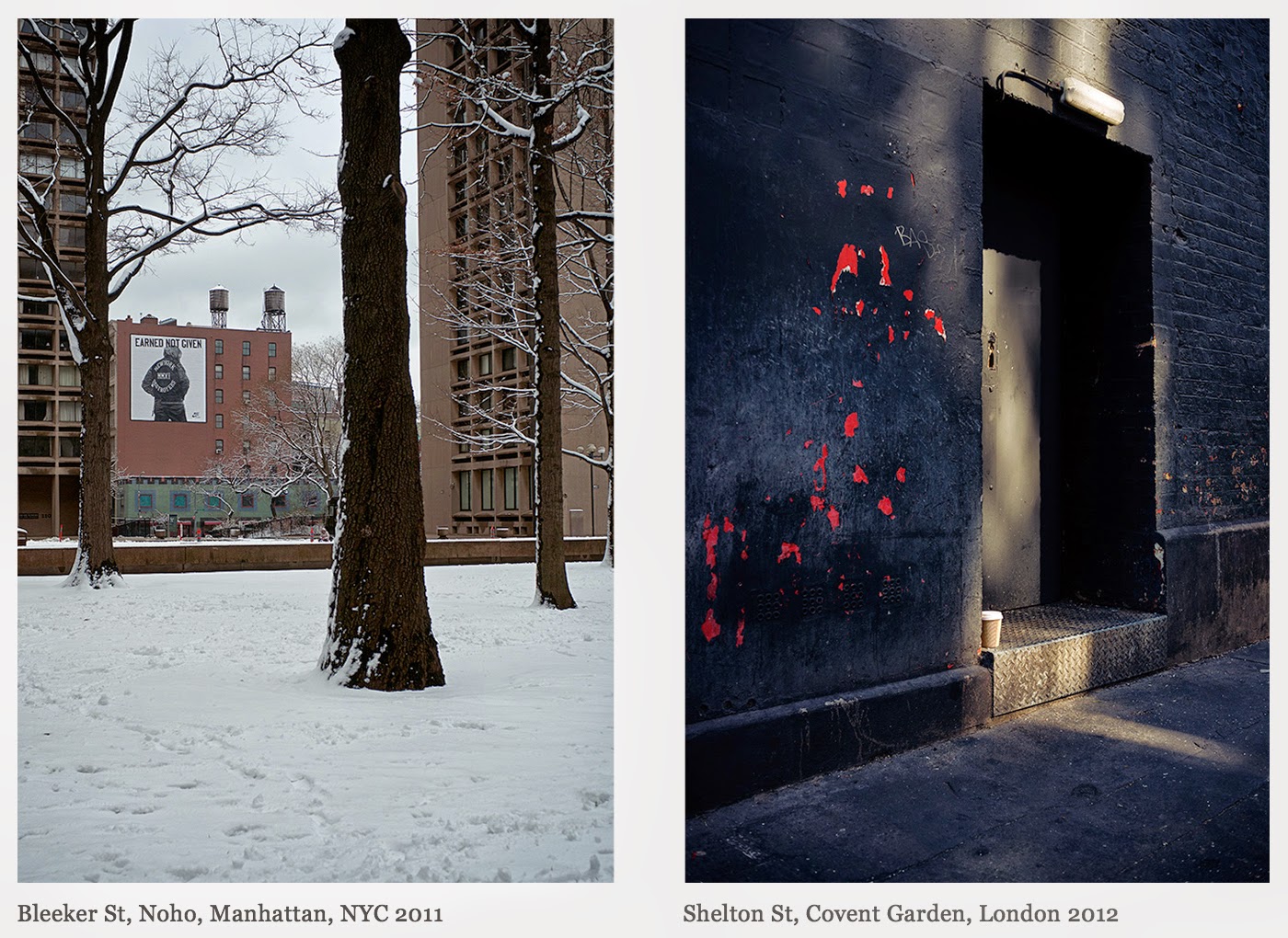
Although Pete spends long hours practically every working day behind the studio camera or in front of a screen processing photographic images, he still maintains an overriding passion for pursuing his personal photographic vision. So whenever work commitments allow and if the light is right, he leaves his studio and heads towards some part of London with his camera in hand. From my first encounter with his work on flickr I have been struck by how he has fine tuned his particular, almost classical - or let's say modernist - way of seeing a city. Besides recording its changing vistas he hones in on details of walls, windows, doorways and pavements, capturing in the materiality something of the city's quintessential character and in the interplay of light and shadows something of its spirit.
__________________________
You've lived and worked in London most of your life, when did you first start to photograph in its streets?
Ironically, it was at a time when I wasn’t actually living here. Though I was born and brought up in South London, in my early teens my family re-located to the West Midlands for my father’s job and it was at around the age of 15 or 16 on day-trips and school visits to London that I first started to make images of the urban environment. Not that it was done with any particular deliberation or discrimination, more just from a general fascination and to make use of my then newly acquired Russian Zenith SLR.

In a way, though, I had been ‘recording’ the city from a much earlier age, when it was a grimier, sootier, shabbier, more darkly atmospheric place than it is today and it held a deep visual fascination for me. From the age of about 7 or 8, I would pester my father to accompany him on visits to the City and when I was 11 years old and travelled by train to my school in Camberwell, I would often go on to the terminus at London Bridge and cross the river to explore the old square mile and climb the 311 steps of the Monument, gazing down on the hustle and bustle of the narrow grey streets. Even now, many of these early ‘latent’ images remain burned onto the retina of my mind’s eye and doubtless inform my way of seeing to this day.
People feature only rarely in your images, why is that?
The flippant answer would be because they won’t stand still long enough, but the real answer is a bit more complex. I actually like getting people in my shots but not in the conventional ‘street photography’ sense, where people are specific individuals and often the main focal point of an image... neither am I particularly motivated to capture the social landscape and dynamic flux of life on the street, so wonderfully epitomised by photographers like Lee Friedlander and Joel Meyerowitz.

I’m more interested in figures when they are an integral formal part of the image and at best a cypher for the human condition. I’m intrigued how even a small part of a figure, a hand or a leg, or even just a shadow can lend a certain scale, resonance and even sense of mystery to what would otherwise be a very minimal and possibly rather obscure image. Consequently, if I’m shooting in places where people are passing through I will often deliberately stay put for a while in the hope that someone walks by and I can capture them in a position and stance that makes an interesting addition to what is already for me a rewarding image.

You often visit and photograph in New York. How different is the experience of shooting in these two cities and what aspects/features do you see as being unique to London?
Visiting any major city is a unique experience due to the specific topography, architectural styles and history, and especially so when one ventures abroad where the unfamiliarity of even the most mundane details; street furniture, signage, etc., help to see everything with fresh eyes... but the contrast between London and New York is a rather particular and extreme one, and the experience of shooting in both places is accordingly quite different.

New York - Manhattan in particular - is a truly modern planned city. Its gridiron of wide avenues with intersecting streets and the 1916 Zoning laws which stipulate the setting back of buildings, have a huge impact on both the appearance of the city and how sunlight can travel unhindered along its entire length or across its width. Consequently, it offers up some surprisingly broad vistas and long perspectives, a sense of deep space that is almost at odds with the sheer scale and density of the place and a characteristic proportionality and boldness to the vertiginous architecture that whilst awe inspiring still retains a certain balance and harmony. Then there is the ‘love it or hate it’ frenetic energy of the place, very much ‘on the street’ and very much ‘in your face’. It all makes for a very dynamic and immediately photogenic environment.

London, on the other hand, is an ancient city and, despite being burned to the ground in 1666 and blitzed by the Luftwaffe in 1940, the old ‘square mile’ in particular still retains its dense labyrinthine medieval street plan. The rest of the city expanded piecemeal over the centuries, absorbing previously separate communities into a huge sprawling patchwork of a metropolis. It defeated grandiose schemes to impose more uniform and ordered structure upon it, as Haussmann did in Paris, and even the river Thames refuses to flow in a direct path, wriggling serpent like through it from west to east.

Consequently, London is a complicated and cluttered city, often a light trap, a place of narrow winding streets, hidden alleyways, truncated views; a place where the ancient jostles cheek by jowl with the ultra-modern, a hotchpotch of architectural styles and wildly contrasting scales. It’s also in a constant state of renewal and redevelopment, frantically trying to modernise and improve, to satiate a seemingly never ending demand for more and more space.

If London has a ‘uniqueness’, it lies in this hugely varied and ever changing landscape. Because of this, it is at once endlessly fascinating but very challenging to photograph; it doesn’t give itself up easily and frequently one has to tread and re-tread the same streets before something magical eventually reveals itself. The broader chiaroscuro of the structures that one is impressed by in New York are rarely afforded in London and when sunlight penetrates the narrow streets, it’s often as slender slanting slices or as reflections from high windows and glass sided buildings. This focussed, discreet illumination naturally engenders a more detailed and intimate observation of the surfaces and intricacies of the fabric of the city.
Consequently, London is a complicated and cluttered city, often a light trap, a place of narrow winding streets, hidden alleyways, truncated views; a place where the ancient jostles cheek by jowl with the ultra-modern, a hotchpotch of architectural styles and wildly contrasting scales. It’s also in a constant state of renewal and redevelopment, frantically trying to modernise and improve, to satiate a seemingly never ending demand for more and more space.
If London has a ‘uniqueness’, it lies in this hugely varied and ever changing landscape. Because of this, it is at once endlessly fascinating but very challenging to photograph; it doesn’t give itself up easily and frequently one has to tread and re-tread the same streets before something magical eventually reveals itself. The broader chiaroscuro of the structures that one is impressed by in New York are rarely afforded in London and when sunlight penetrates the narrow streets, it’s often as slender slanting slices or as reflections from high windows and glass sided buildings. This focussed, discreet illumination naturally engenders a more detailed and intimate observation of the surfaces and intricacies of the fabric of the city.

Are there particular places / sites in London that you prefer to record?...and why?
Not really. I suppose because I never set out to record anything in particular I enjoy exploring and shooting in a wide variety of urban topography; from areas of ultra-modern office developments all the way through to places of post-industrial dereliction, or from the busy bustling main street areas to quiet backwaters. Variety, as they say, is the spice of life and that’s certainly not a problem in London. I also tend to gravitate to certain areas that have proved fruitful in the past, often visiting them repeatedly until eventually I suffer a visual fatigue or over-familiarity, at which point I’ll go elsewhere, maybe to places I’ve neglected for a period of time. I try not to be too organised about these things and rely on mood or impulse to take me. I actually prefer wayward wandering and like not having a plan or a route or a task; I have always found that the more I set out looking for something in particular, the less likely I am to find it.

I see a certain tension in your work between the motivation to document slices of urban reality, warts and all if need be, and a desire to highlight the formal elements in the picture plane with the result that images hover between the documentary and something else, an abstraction of reality perhaps. If you had to categorise the works presented here, what would that be?
That’s a really difficult one for me and I’ve struggled in the past to come up with even half an answer. In a way, it goes to the very heart of what photography is for me... but to categorise it seems fraught with problems; I seldom use photography just to document things, but all my photographs are de-facto documentary; my images are often minimal, ambiguous and lack any narrative but they are not necessarily abstract; I don’t have specific themes I consciously explore or rigorous concepts I adhere to and yet even images I made over 30 years ago exhibit undeniable pre-occupations and commonalities of style with images I am making now; my pictures are rarely about the surfaces they describe and yet I prefer highly resolved critically exposed images rather than softer, more fluid and impressionistic ones.

I should, I suppose, add the caveat that I’m far from being monomaniacal with my photography; although at it’s core it is predominantly a highly personal form of self-expression, I also use photography in more prosaic ways too; to record signage, typography and old store fronts, or to examine the endlessly fascinating accretions, abrasions and ablations that the fabric of the urban environment is subjected to by the passage of time and humanity. I’ve even been know to take the odd furry feline picture.
I should, I suppose, add the caveat that I’m far from being monomaniacal with my photography; although at it’s core it is predominantly a highly personal form of self-expression, I also use photography in more prosaic ways too; to record signage, typography and old store fronts, or to examine the endlessly fascinating accretions, abrasions and ablations that the fabric of the urban environment is subjected to by the passage of time and humanity. I’ve even been know to take the odd furry feline picture.

Ultimately, I always come back to the same conclusion; that my ‘personal’ images are simply gut reactions to a particular place at a particular time; they are ‘touchstones’ - either for a brand new emotional experience or as a ‘Proustian’ resonance with older memories - a sort of visual condensate, much like the way particular pieces of music can be incredibly evocative, or simply make the hair on the back of one’s neck stand up.

Of course, it would be churlish to pretend that in the act of creating these ‘touchstones’ there isn’t also an attempt to make them aesthetically interesting and appealing (or even challenging); to divine some order in the chaos, perhaps even to create a beautiful image from what would commonly be considered mundane and banal (different, I suspect, from a post-modern approach of proposing the mundane and banal as an aesthetic in itself). I suppose in many ways the images are probably best categorised as being the working notes of a Flâneur, that rather particular activity of wandering without any specific intent or final destination, but simply to savour and enjoy the rich visual experience that the urban environment can offer; ‘the gastronomy of the eye’ as Balzac described it.

Of course, it would be churlish to pretend that in the act of creating these ‘touchstones’ there isn’t also an attempt to make them aesthetically interesting and appealing (or even challenging); to divine some order in the chaos, perhaps even to create a beautiful image from what would commonly be considered mundane and banal (different, I suspect, from a post-modern approach of proposing the mundane and banal as an aesthetic in itself). I suppose in many ways the images are probably best categorised as being the working notes of a Flâneur, that rather particular activity of wandering without any specific intent or final destination, but simply to savour and enjoy the rich visual experience that the urban environment can offer; ‘the gastronomy of the eye’ as Balzac described it.
What is it that motivates you to hone in on such details and what do you think they show or communicate? Do they communicate something about you?
The premise of ‘honing in’ on certain details is to a certain extent erroneous as it’s more about framing an image in a way to ‘see through’ the inevitable clutter and visual distractions of the urban environment; to find a composition that simplifies and clarifies; an attempt to reach the essence of what caught one’s eye in the first place. That may sound somewhat pedantic, but it’s a way of emphasising the fact that it’s not the materiality per se of the things appearing in the frame that is of primary importance; much more pertinent is the way arrangements of three-dimensional space, textures, lighting and colours can transpose and compress themselves via a lens onto a flat two-dimensional plane and create an image that is something particular and unique in itself, not simply a highly detailed representation of the actuality.

That this process of reduction and isolation often highlights the details of the urban fabric is something of a by-product, though not an unwelcome one; part of the intrinsic nature of photography is its unparalleled ability to indiscriminately delineate the minutest details of our environment, right down to the most humdrum things, which we look at every day of our lives but rarely see, and it’s the dynamic that exists between this sublime rendition of details and the broader simplification and compression of shapes and space and tones that is uniquely photographic; that push and pull between the absolute flatness of the photographic surface and the illusion of depth and texture, focus and blur, light and shade within it.

In that sense, such details tend only to show or communicate the nature of themselves; whether that may also communicate to other viewers something more is entirely dependent on their frame of reference. Likewise, what the images communicate about me is my way of seeing, my visual sensibility and I seriously doubt anything more of my personality can be divined from them.

How does this work differ from your meticulous commercial work in the studio; do you see any spillovers from one to the other?
It’s very much a yin-yang thing; commercial studio work is in many ways the polar opposite of personal photography in the outside world, but inevitably each discipline informs and references the other. The core of the difference is that my studio photography (mostly product still life) entails creating a highly manipulated reality in front of the lens and the camera frame is relatively passive, something akin to a theatrical proscenium arch, through which this fabricated scene is arranged, illuminated and designed to be viewed, whereas outside of the studio, which is itself literally a ‘camera obscura’, the world at large is a continuum, uncontained and limitless, ever changing and ungovernable, so the camera frame becomes something much more dynamic, pro-active and discerning; a way of isolating some small fragment of that vast reality and seizing a moment in the flux of time and light. Consequently, the contrast between the two ways of working is so great that when I venture out with my camera, I don’t have to ‘shake off’ the highly meticulous, manipulative and formal way of working in the studio. I do sometimes think I could be more spontaneous and quixotic with the camera on the street, but in truth a certain amount of formality and consideration with framing and exposure is definitely an intrinsic part of my personal work anyway, albeit not to the painstaking extent required in the studio.

What is it that sometimes makes you decide to produce images in black and white?
At the risk of sounding simplistic, because it’s how I saw those images when I took them. Anybody who engages with photography at even a fairly basic level easily recognises that some images work much better as monochromes and some images are effective mostly because of their colour content, but the real issue for me is pre-visualisation, which is about seeing a final two-dimensional image in my mind’s eye, even before I press the button to make the exposure, and that inevitably includes determining whether it should be in colour or B&W. It’s not, however, done in an overly conscious way, more as an intuitive process, like being properly bilingual and able to think as well as speak in two different languages. Occasionally, I subsequently find that an image I had envisioned as monochrome also works very well in colour and that the two versions are actually both valid images in their own right; rarely do I find the opposite, that something initially shot as a colour image can make a good B&W.

You studied Fine Art, which visual artists influenced you?
Oh boy, that’s such a long time ago now and quite where the distinction lies between being influenced by or simply inspired and impressed by, is another difficult consideration; for what it’s worth, here, in no particular order, is a short list of artists who’s work I’ve long admired and when I see it, can still raise the hair on the back of my neck: Turner, Whistler, Rembrandt, Francis Bacon, Picasso, Martin Lewis, Caravaggio, Hans Holbein (younger), Rothko, Hiroshige, and Velàzquez. Don’t ask me why.
Where do you get your inspiration?....other photographers?
Inspiration, in the sense of something that enthuses and motivates me to go out and make images, rather than directly suggesting a subject matter or stylistic approach, comes from many directions. Of course, when I was younger and still trying to get to grips with the medium, the work of other photographers was hugely important, but even then I was also very inspired by movies and cinematography, particularly film noir, as I am to this day.

Traditional visual artists (see above list) also provide inspiration, as does music, which I listen to constantly in the studio. When I hear something that really strikes a chord (excuse the pun) it has a way of linking up with my mind’s eye as a direct corollary of the visual idioms that pervade my images; not exactly classic synaethesia where different musical notes illicit the actual perception of colours and shapes, but something akin to it. In more recent years I have certainly found my contact with fellow photographers on sites like Flickr to be very inspirational... like many forms of visual expression, photography is a fairly solitary endeavour and it’s reassuring to know that you are not the only person prowling about the streets, furtively sizing up drain covers or brick walls, killing time before the men in white coats come to get you.
Traditional visual artists (see above list) also provide inspiration, as does music, which I listen to constantly in the studio. When I hear something that really strikes a chord (excuse the pun) it has a way of linking up with my mind’s eye as a direct corollary of the visual idioms that pervade my images; not exactly classic synaethesia where different musical notes illicit the actual perception of colours and shapes, but something akin to it. In more recent years I have certainly found my contact with fellow photographers on sites like Flickr to be very inspirational... like many forms of visual expression, photography is a fairly solitary endeavour and it’s reassuring to know that you are not the only person prowling about the streets, furtively sizing up drain covers or brick walls, killing time before the men in white coats come to get you.

I’d hesitate to attempt a list of all the photographers who have inspired me, it would be very long and I’m sure, due to my sieve like memory, have many notable omissions, but certainly Robert Frank, Ralph Gibson, Walker Evans, Lewis Hine, Paul Strand, Edward Weston, Eugene Atget, Bill Brandt, André Kertész, Manual Alvarez Bravo, and Berenice Abbot were some of my earliest heroes and in more recent years Saul Leiter, Bruce Davidson, William Eggleston, Max Yavno, Lewis Baltz, Vivian Maier and Ray K Metzker have all made me want to put on my walking shoes, sling the camera bag over my shoulder and venture out to try my luck.
Lastly, but by no means least, there is the inspiration that comes from staring out of windows, which as a primary school teacher once observed in my form report, I am very adept at.

You used to shoot film in the past, besides the obvious differences in the processes involved, what do you see as the main differences between digital and film?
Aside from the fact my camera bag is lighter because I don’t have to lug around filters and film, the actual act of photography is for me almost exactly the same; I see a shot, I compose and focus, I calculate the exposure, I shoot at least 3 frames. The real notable disparity between film and digital lay in the nature of the image that is recorded. Traditional film records light in a specific non-linear way and each type of film stock has its own characteristic response curves and colour balance. Consequently, one makes a major decision about the way images will be rendered prior to shooting, and that parameter remains until the roll of film is finished. Digital (RAW) capture, on the other hand, records light in a completely linear way and the tonal response and colour balance can be determined post-exposure for each individual capture.
This is not to say one is better than the other and a preference for either one is a personal thing, often very much dependent on an individual way of working and differing sensibilities. Some photographers welcome the idiosyncrasies and characteristics of various film types, relishing the nuances they bring to images as part of the challenge of finding the right combination of lens, film stock and chemistry to realise their vision. Others enjoy using digital capture because of the flexibility in shooting and the amount of precise control one has over all the image parameters; for me digital is like using a film camera where one can change at will, frame by frame, the film type and then choose the processing chemistry for each individual image. Many, of course, enjoy the challenges of both disciplines but I can’t chew gum and walk at the same time, so stick to just using digital and I‘m content to have my old film cameras as bygone objects of curiosity on a shelf in the studio.
I suppose I am at a certain advantage in that my professional work allows me ample opportunity to study and experiment with the technicalities of digital capture and find ways to make it work uniquely as part of my individual way of seeing, rather than just accepting the generic outputs offered by the camera and software manufacturers. There is, I think, a common misconception that digital capture is a more ‘automatic’ way of capturing images than conventional film and processing; it’s not, it’s just different and like all media, a thorough understanding of its underlying principles and workings is necessary to fully exploit the process as an expressive medium.
It’s not without compromise and there are still areas where digital capture is inferior to film, but film is certainly not without its own compromises, as, in fact, are all types of media; coping with those compromises and finding ways to mitigate or deliberately utilise their effects is an intrinsic and fundamental part of learning the craft of any expressive medium. Nor should we forget that digital capture is still in its relative infancy and the only way it moves forward as a medium is by people using it, pushing the boundaries, testing it to the limits and then demanding more from the manufacturers, which is exactly what happened with traditional film photography. Had it not, we would all still be coating glass plates with wet collodian, poisoning ourselves with the toxic developers and pushing our cameras around in handcarts.
I will concede that there is a true sense of wonder in seeing an image slowly appear on a blank piece of photographic paper as it is rocked gently back and forth in a tray of developer, but I shot film for almost 30 years and oftentimes more film in a day than most people would probably get through in a year and I can’t say I really miss it

Would you like to say something about the cameras and lenses you use – how important are these to you in your personal work?
Basically, I travel light; for most of my personal work I now use a Nikon D800E with a Zeiss 35mm f2 lens. For me, it’s the lens that is most important and I suppose experience has played its part, but I find if I can’t make a shot using a 35mm lens on a full frame camera, then a bunch of other lenses isn’t going to help any; that particular angle of view (about 64 degrees) must be pretty much the same as my mind’s eye... or is it that my mind’s eye has simply gotten used to that lens? Very recently I have started to shoot with a Zeiss 50mm Planar (simply because the Planar is such a wonderful lens design and renders images with a very distinct character) and though at first I struggled with the longer focal length, I found to my surprise that with a bit of perseverance, I became accustomed to it quite quickly… though I can’t imagine using a much longer focal length than that.

One could spend a lifetime following endless online forum threads about the various merits or faults of this lens or that camera and ponder list after list of technical specifications, but in truth no camera or lens is perfect. Having one that feels good in your hand, that you enjoy using and that delivers an image quality you like is really the most important thing... if that’s a beat up old TLR that leaks light or a state of the art full frame DSLR, a limited edition Leica or the camera on your mobile phone, it doesn’t matter. The best camera is the one that you simply love using, the worst is the one that’s either so complicated, so heavy, so fiddly or so precious that to use it is an effort and a challenge. I sympathise with other photographers who bemoan the fact that modern digital cameras don’t have the tactile quality of good mechanical film cameras; it’s true and the pleasure of handling those kind of cameras is undeniable, but for me it’s much more about getting out whenever I can to make images, and in a busy life a digital camera allows me to do that to a degree that film cameras don’t.

For the record, the Nikon D800E is the first camera, digital or analog, that I’ve owned (and, boy, that’s a long list) that performs to a level with which I’m almost completely satisfied for my personal work; the full frame sensor with no anti-aliasing filter produces images with bite, the massive pixel count allows the true character and micro-contrast of the lens to be registered and there is sufficient dynamic range to not worry about highlight clipping in all but the most extreme lighting conditions. In many respects it is for me the holy grail of cameras; ergonomically a joy to use, medium format image quality and compact and light enough to carry around all day.
Thank you, Pete Gardner.


_______________________________________________________


